1979 was an year of shifting music trends. Disco had hit its peak in popularity during the summer. The downslide nationally started with the Disco Demolition Night, a baseball promotion at Comiskey Park in Chicago, Illinois on July 12, 1979. The Disco Demolition Night at Comiskey Park in Chicago, Illinois was a baseball half-time promotion that got out of hand. A crate filled with disco records was ignited on the field in protest of disco music. The explosion, and stampede of tens of thousands of rowdy patrons, damaged the field and the Chicago White Sox had to forfeit the second game of the doubleheader to the Detroit Tigers. Disco was on its way to fade away. Disco met its ultimate dethroning.
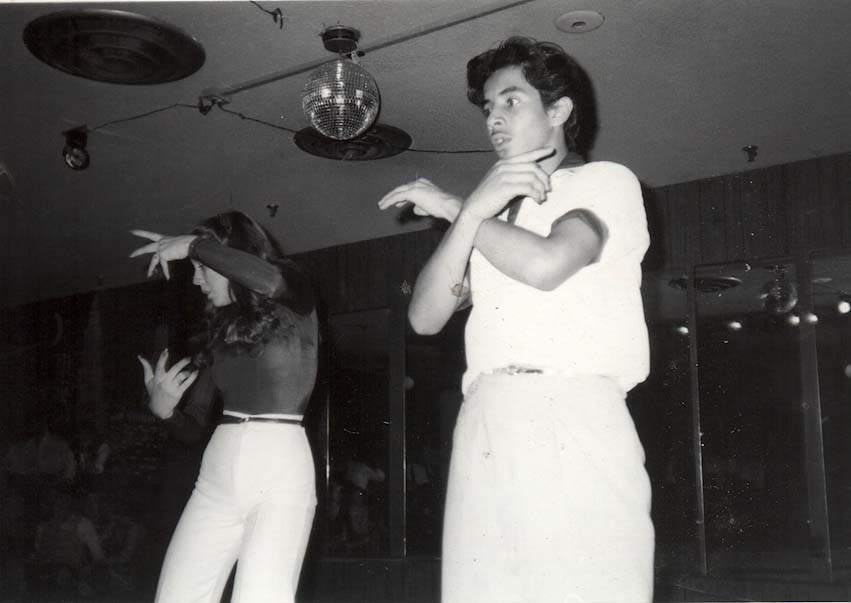
New Wave music developed out of the underground as artists like Talking Heads, Blondie, and The Police made their way into mainstream music. Ska and hip-hop was just starting to make its influence on the music scene. Hot groups like Blue Oyster Cult, Smashing Pumpkins, Van Halen, and Moody Blues made Tucson performances. It was this year that the Sony Walkman hit the market while Steve Jobs and Stephen Wozniak were busy developing the personal computer. In Tucson, local country band Chuck Wagon and The Wheels (now Chuck Wagon and The Wheelchairs) released their second LP entitled “Country Swings, Disco Sucks.” The album received national attention.
During the spring of 1979, the City of Tucson wanted to expand summer opportunities for youth with a series of citywide Summer Teen Disco Dances. As a spin-off from the Youth Awareness Week Community Town Hall several agencies, including Youth Awareness Press, joined with the Tucson Parks & Recreation department to produce teen dances around the city during the summer.
In late April, representatives from Culturecraft Int’l., a Tucson concert promotion company, offered to tie in a Youth Awareness Press fundraiser with its upcoming concert, the Desert Springs Rock Festival, a Memorial Day music festival held on Saturday, May 27th. The event featured six local bands, but only about 500 people showed up for 10 hours of rock, jazz and soul at the Pima County Fairgrounds from noon to 10:00 pm. It was an extreme disappointment and a total bust. Fortunately, only our time commitment was the cost.
From 1979-1987, the Bourbon Street Jazz Band played at Gus & Andy’s. The front line stated the same, and Tom Lemmol, drums, and Clarence Svendsen, piano, joined Len in the rhythm section. Mary Jane joined the band in 1981, when Clarence retired, and Ed Ross became drummer when Tom left. Bill Eagle, trumpet, took Manny’s place in 1983. Manny passed away in April 1984.
Tucson gained a new radio station in 1979 with a new music format. They are both found on KTKT-FM (96 Rock), Tucson’s only pure rock and roll radio station. Explains Ed Alexander, program director for KTKT-AM and FM, “Whenever I listened to rock and roll (stations), it’s been watered down with pop, disco, jazz … On this format, if you want rock, you get rock.” The format is described as “album-oriented rock and roll,” and is the brainchild of the Burkhart-Abrams firm, which programs stations nationwide. 96 Rock will sound like Tucson, however, not like Phoenix, nor any of the other 50-plus cities that Burkhart-Abrams handles. The Tucson sound is attained through KTKT-FM’s ongoing music and audience opinion surveys, local promotions and a general involvement with the community.
Best representing the station’s community-oriented image is the news department, headed by Rob Ritter. In addition to the hard-core stuff, the news offers public service programming such as a calendar of events, Mexican-American programming, talk shows, and “lifestyle news” geared to 18-34 year olds, which are the station’s target group. The key word at 96 Rock is, of course, music. Tying everything together is the 96 Rock air talent– M.J. (6:00AM to 10:00AM); Ziggy (10:00AM to 3:00PM); Allen Browning (3:00PM to 7:00PM); Bryan Miller (7:00PM to midnight); Ted Carradine (Midnight to 6:00AM); and Robin Wells (weekends). They all are very enthusiastic about the station, its audience and new format. As Alexander puts it, “If you want rock and roll, you know where to come. We won’t chase you away with the other stuff.” Alexander has been elected to the Board of Directors of the Southern Arizona Chapter of the March of Dimes. He continues to serve as chairman of the annual Superwalk. (By Bryn Bailer, From Youth Awareness Press, Autumn 1979).
The Midway Drive-In, 4500 E. Speedway, was built in 1948 and closed in 1979. The Prince Drive-In Theater was located at 2015 E. Prince on the Northeast corner of the intersection of Prince Road and Campbell Avenue. It opened in 1953 and closed around 1979.
…
The following is a reprint by Tracy Landers, Autumn 1979 – Youth Awareness Press. Page 10:
If you like to race, the Malibu Grand Prix is your place! They have formula cars that go up to fifty miles per hour on a winding, professional track, and they also have a large game room with over one hundred action machines. “Everyone comes here,” says Michael DiGiovanni, the manager. The most exciting night at Malibu is Saturday when all the teens come to play the machines and race. “More people play the pinball machine, “Flash,” than any other game we have,” says Michael. Malibu Grand Prix is open from noon till 2:00AM seven days a week and is located at 4002 E. 22nd Street.
The Gold Mine is another exciting game room located in El Con Mall. Assistant manager Joe Kelly says they have fifty-nine machines including one called Space Invaders and the popular pinball machine called Flash– two of the most played games. The Gold Mine is open from 10:00AM till 10:00PM seven days a week.
Do you like a choice of things when you go out? Then why not try Golf ‘n Things. They have golf, games and bumper boats. It’s fun for families, and teens of all ages. “More people who come here also prefer to play Flash more than any other game we have,” says new manager Ted Williams. “We have one hundred and fifty machines that you can play anytime Sunday through Thursday, nine a.m. to midnight and Friday through Saturday, 9:00AM to 1:30AM.” Golf ‘n Things is located at 6503 E. Tanque Verde Road.
Have you checked out the Fool Around lately at 940 E. University Blvd? “You can play our fifty machines including pool for only thirty-five cents,” says manager Gary Eastman. “More people play video than anything else. Among our seven video games is the popular Space Invaders.” Fool Around is open seven days a week: Sunday through Thursday 8:30AM to midnight and Friday through Saturday, 8:30AM to 2:00AM.
Do you like pool and pinball? Old Pueblo Billiards at 3825 E. Speedway has pool and games featuring Tornado Foosball. You can play their games any time, seven days a week because they’re open twenty-four hours a day.
Green Acres Golfland is located at 6118 E. Speedway. They have a large game room of Pinball, Air Hockey, Foosball, and many other skill games. You can play their games seven days a week from 10:00AM till midnight.
Step into the wonderland of Magic Carpet Golf. They have two skill golf courses you can play, along with their
Step into the wonderland of Magic Carpet Golf. They have two skill golf courses you can play, along with their Cameroon featuring a shooting gallery, seven days a week from eight a.m. till midnight. Magic Carpet is located at 6125 E. Speedway.
Sports: A new season with the Tucson Toros
The following is a reprint by Anne Griffin, Winter 1979-80 – Youth Awareness Press. Page 15:
The 1978-79 season started out well for the Tucson Toros. For most of the first half, it looked as though the Toros were to win the first title in their division of the Pacific Coast League. The Tucson Toros were doing great until they played a three game series with the Albuquerque Dukes. The Dukes swept the series and cut the 6-½ game lead the Toros had over them to 3-½ games (The Dukes eventually won the title).
The Toros, however, were still in the race until the parent club, the Texas Rangers, began to make trades and call up players. A trade sent the Toros’ starting catcher Mike Heath to the Oakland A’s; another sent one of Tucson’s top hitters Gary Holle to the Chicago White Sox; and the Rangers called up second baseman LaRue Washington and pitcher Danny Darwin.
The trading of Holle and Heath, and the calling up of Washington and Darwin, led the Toros to call players up themselves. They called up two from Class AA: Tulsa catcher Fla Strawn and second baseman, Ron Gooch. Strawn was here for only a month, but Gooch remained.
In July, there was talk of a trade that the Rangers wanted to make. This trade would have sent Mickey Rivers from the Yankees to the Rangers. In exchange, the Rangers would have sent Mike Hart, Gary Gray and two other players to the Yankees. However, the trade was voided by Baseball Commissioner Bowie Kuhn because Hart and Gray did not clear waivers. The trade between the Yankees and the Rangers did go through, however, with Oscar Gamble going to the Yankees and Mickey Rivers going to the Rangers.
A dispute between the Toros and Rangers concerning exhibition games played here led to the severing of the contract between these teams. After negotiation with all of the Major League teams, the Toros narrowed their choices to ten teams; then, finally one. Happily, the Tucson Toros are now the top farm club of the Houston Astros.
“It’s an exciting organization,” comments Jack Donovan, general manager of the Tucson Toros. “We thought it was the best move for the City of Tucson.”
“I think Tucson is great. It’s a pleasure to be here. This is a good place for the kids to play in and live in, they won’t have to worry about things they shouldn’t have to worry about,” said Bill Wood, Minor League Director of the Astros who was present during this interview.
The Astros are the fourth parent club that the Toro’s had– the others being the Chicago White Sox, from 1969-1972; the Oakland A’s, from 1973-1976; and the Rangers, from 1977-1979.
The Toros had a tremendous Booster Club headed off by Fred Kalat, “Freddie the Toro.” The booster club was doing something for the players, their wives, the reporters, and were always helping the management. General
Manager of the Toros, Jack Donovan, summed up the season, “It was a great year, enthusiasm stayed even though Tucson didn’t win the pennant.”
Sources:
“Youth awareness Press” 1979
“Entertaining Tucson Across the Decades, Volume 1.”