
By Bryn Bailer Summer 1979 – Youth Awareness Press
Reprinted in “Entertaining Tucson Across the Decades,” Volume 1
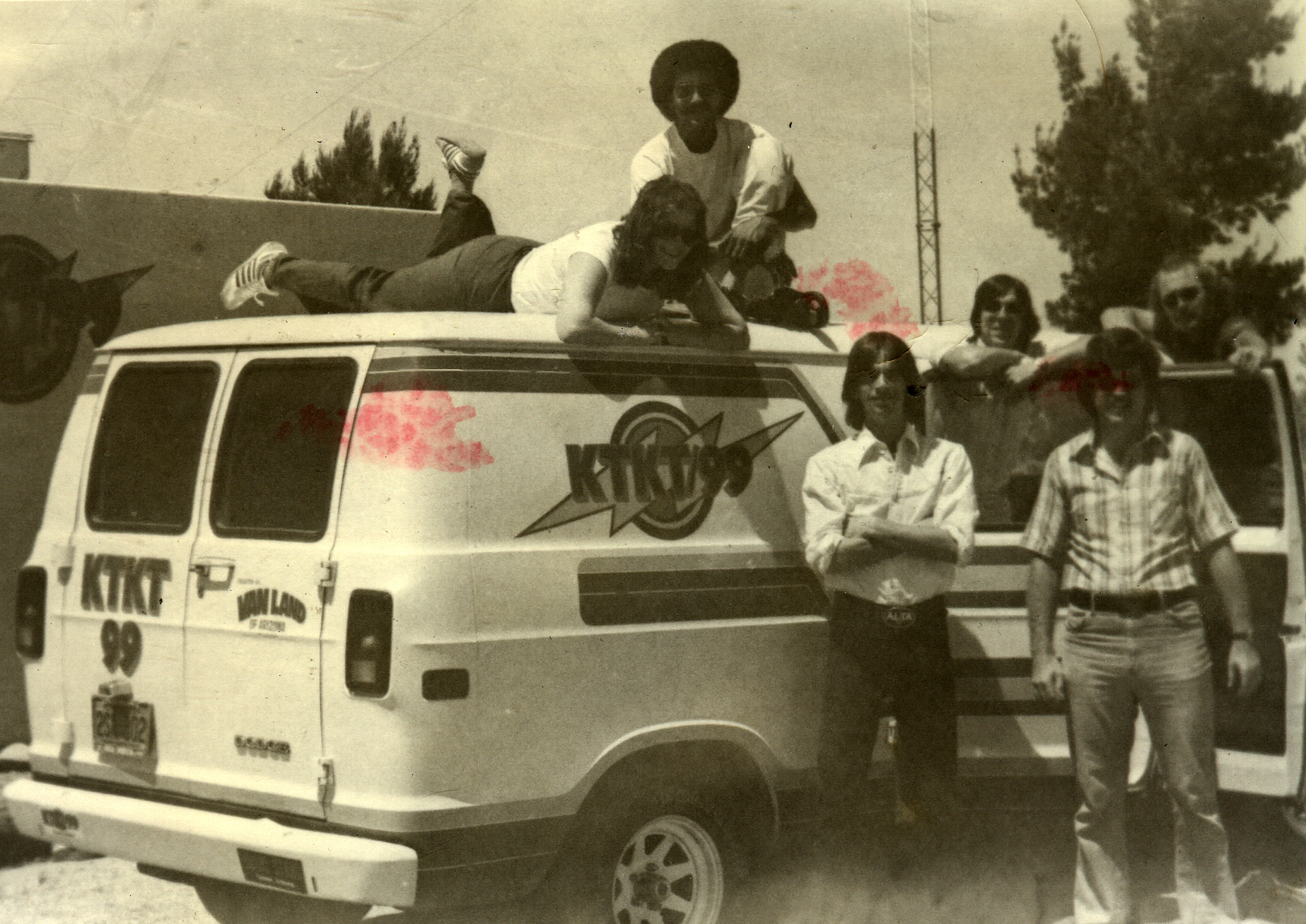
From the outside, top radio station KTKT-99 AM appears to be nothing more than a one-story, adobe-colored building in the middle of desert scrub and surrounded by a ring of five towers. But it isn’t the building that has earned KTKT a prime position on the ratings charts– the people have.
According to Mark Schwartz, KTKT’s the pipe-smoking general manager, “KTKT represents to Tucson a lot of history, a lot of actual trendsetting. “We’re alive. We’re today. We’re the lifestyle that people are leading.”
But the KTKT Tucson relationship doesn’t stop here. Schwartz stresses the great commitment KTKT feels toward southwestern Arizona, Tucson in particular. “We’re in a city that we feel is a tremendous growth city, a city that has been very good to us,” he says. Tucson has been so receptive, in fact, that KTKT has plans for a new contemporary station, KTKT-FM.
KTKT-AM and FM will be separate stations, each having its own image, format and approach. But that’s the future. What are the reasons behind KTKT’s present success?
“We like to be first.” Schwartz says, gesturing with his pipe for emphasis. “We feel it’s our responsibility. If you’re going to call yourself a leader, you have to lead.” A few of KTKT’s “leadership firsts” include a fund-raising basketball team, a referral service (Call for Action), a station van, and Tucson’s first full-lime female Top 40 disk jockey.
Don Beetcher, sporting a mustache, boots, and electric blue eyes, is the 10:00AM to 2:00PM air personality whose show is living proof of KTKT’s ability to keep up with the times. It was originally a “strictly female-type show,” but then it was discovered that quite a few of the afternoon listeners are “househusbands” who stay at home while their wives work. “We try to play a mass-appeal type of music on the show because we’re reaching almost everybody who has access to radio– young adults, men, as well as women.”
How does Beetcher, also operation manager of KTKT, prepare himself to ‘appeal to the masses?’ “A lot of people think you just walk in, play what you want, say what you want, do what you want.” He grins at the thought. “It’s not like that at all . . . I try to recollect a whole bunch of thoughts early in the morning, write ‘em down, and prepare them for my show.” He goes on to say that ideas often come to him while he’s in the car, and he’ll end up driving with one hand while writing with the other. “You should be in a good mood when you go on the air,” he comments, “And you should be ready to do four hours of work.”
A big part of Beetcher’s show is entertainment. But, just like the records they play, KTKT has a flip side.
Beetcher explains, “we feel it’s important to do something for people other that just giving them music … you see us actively taking part in the March of Dimes, Multiple Sclerosis, Walk-a-thons… The list goes on. We try to do and to help as much as we can.”
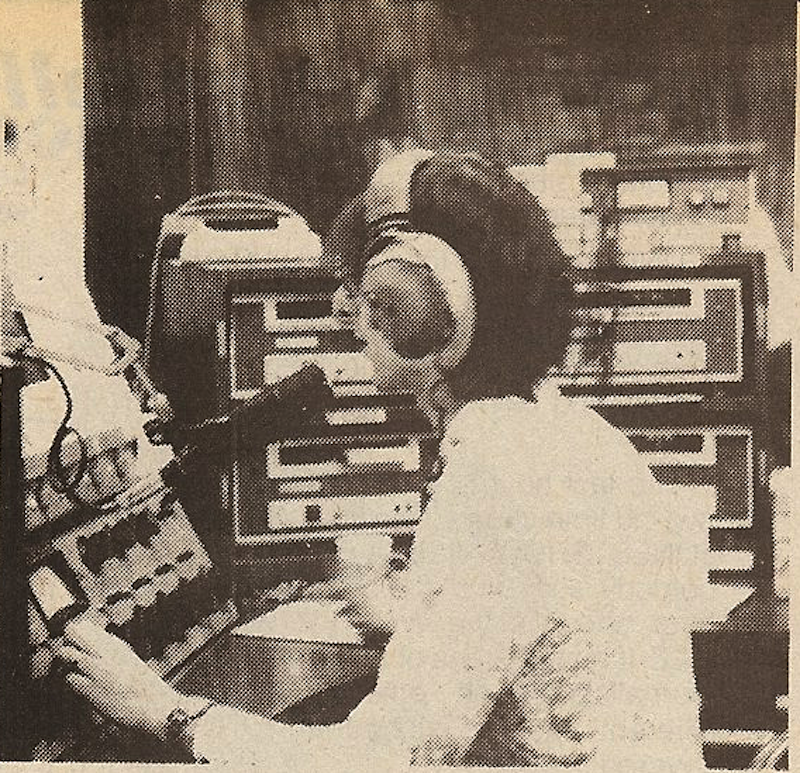
Ed Alexander, (Photo above) whose name is synonymous with The March of Dimes, KTKT’s programming director, and the 6:00AM to 10:00AM morning show, is not quite as big as one might expect from hearing his voice, which has the same rich quality off the air as it does when he’s speaking into several thousand dollars worth of sound equipment.
Referring to the benefits of his profession, Alexander cites such things as “all the concerts you can go to, and all the records you can eat” but he also mentions that he gets to meet a lot of interesting people, from superstar celebrities to “just neat people that you meet.”
Alexander has been an aspiring D.J. since he was about nine years old (despite his parents’ first reaction: “Oh, my God! A disk jockey? When is he going to get serious?”) He was in a few bands in high school, and reputedly did a great Mick Jagger imitation, but eventually moved into the announcing field. “The best thing about it is that there’s always something new,” he says, taking a swig of Dr. Pepper, “news, music, audience reaction … it’s ever-changing. “
One thing that doesn’t change much is the limelight– it always seems to be focused on Alexander– and at the same time, on the station. Described by general manager, Mark Schwartz, as “the single most received personality in Tucson. Alexander has plenty of stories to tell about being recognized at baseball games, McDonalds, and the like. “I’ve been around for a while now, and people know me by face.”